
By Sen. Jeff Bingaman (D-N.M.) - 02/01/11 06:56 AM ET
Sen. Jeff Bingaman (D-N.M.) gave these remarks Monday at the New Democratic Network and National Energy Policy Institute.
At the beginning of this new Congress, it is already becoming clear that energy policy will have a major place on this Congress’ agenda.
Part of that is because the President made clear last week in his State of the Union speech he will give energy a major priority in his administration.
In part, it is because our energy security is dependent on overseas supplies and global stability. The events that we have seen unfold in North Africa and the Middle East are stark reminders that the world is an unpredictable place. Whenever geopolitical events potentially affect our access to affordable energy supplies, it is a spur to consider energy policies that might reduce those geopolitical risks.
But perhaps more important than any of those reasons is the competitive pressure we are experiencing from other major world economic powers, as they take a very leading role in clean energy markets.
According to Bloomberg New Energy Finance, new investment in clean energy globally reached nearly a quarter of a trillion dollars in 2010. That was a 30 percent jump from where it was in 2009, and a 100 percent increase from the level in 2006.
China alone invested $51.1 billion in clean energy in 2010, making it the world’s largest investor in this sector. China now manufactures over half of the photovoltaic modules used globally. In 2010, China installed about 17 gigawatts of new wind capacity – roughly half of the total capacity installed globally – with virtually all the equipment being supplied by its domestic manufacturers.
But the concern about the competition for clean energy jobs is not just about China. Europe also made major strides last year towards competing in these markets. Countries like Germany, the Czech Republic, Italy, and the United Kingdom, have emphasized small-scale distributed electricity generation projects. In Germany, 8.5 gigawatts of new photovoltaic capacity were added in 2010. So there is a lot going on around the world in that area.
We also see that other countries consume energy more efficiently than we do. According to the International Energy Agency (or IEA), Japan, the United Kingdom, and Canada are all ahead of the United States in implementing policies to make sure they get the most out of every BTU that they consume. Japan has its “Top Runner” program, which encourages competition among appliance and equipment manufacturers to continuously improve the efficiency of those appliances and that equipment.
So the question is, how do we respond to this competitive world for the clean energy jobs? I believe that to remain at or near the forefront of this strongly developing market, we need to do at least four things:
First, we need to ensure that we remain at the forefront of energy research and development, since innovation is the source of our greatest competitive strength. The President made that point in his State of the Union Speech and in other forums, as well.
Second, we must ensure that we have a strong domestic market for clean energy technologies. Without clean energy market-pull in the United States, there will not be the incentive to manufacture and deploy these technologies here.
Third, we have to ensure that we have the necessary financial infrastructure and the incentives to provide the capital needed to build advanced energy technology projects.
And finally, we need to have explicit policies to promote the development of U.S. manufacturing capabilities for these clean energy technologies
I think these four items or elements should be at the heart of whatever comprehensive energy legislation that we undertake in this Congress. Let me say a few more words about each of them.
The first item to consider is support for advanced energy technology R&D. America has traditionally led the world in many of the characteristics that are essential to having an innovation economy. We have the predominant share of the world’s best research universities. We are the world’s largest source of financial capital. We have a disproportionate share of the world’s leading innovators in high technology. But these advantages are shrinking rapidly. In 2007, United States energy research expenditures were at about 0.3 percent of GDP. Japan was at about 0.8 percent of GDP and even China was about 0.4 percent. Since then, our overseas competitors have significantly increased their research investments in energy, while our own investments in this area have grown only modestly. It is clear that if we are to put together any kind of bill that deserves to be labeled as comprehensive energy legislation, we need to address the huge gap between where our investment in energy technology research is and where in fact it ought to be.
In his State of the Union address, President Obama correctly identified this as a major priority for the appropriations process this year. Secretary Chu will appear before the Committee on February 16 to testify about the details of the President’s plan for funding, which will be released on Feb. 14.
The second item is ensuring robust domestic demand for clean energy technologies. It is not enough just the support the research. Getting clean technologies developed, manufactured and deployed here in the United States will require a robust and certain demand for clean energy in the marketplace. This reality was underscored to me during a trip recently to Silicon Valley. I spoke to various people there involved in financing and developing clean energy projects. The message I heard consistently was that uncertain U.S. demand for clean energy is preventing many promising clean technologies from being developed in this country. Companies will not establish a manufacturing base where they do not see a strong market. Private capital sources are, in fact, exerting intense pressure on American clean energy innovators to establish their manufacturing base overseas, where government policies are creating this strong clean energy demand.
So, we have to take seriously the marketplace reality that the high-wage, clean-energy manufacturing of the future will be located both close to demand and in countries with the most favorable clean energy policies. My desire is to see the United States lead the world in renewable energy manufacturing so all of the solar panels and wind turbines that we install around the country are not stamped “Made in China” or “Made in Germany.” This is the key reason why I have long supported a Renewable Electricity Standard. We need to provide long-term market predictability for renewable electricity. Our on-again, off-again production tax credits are no match for the comprehensive approaches being put in place by our economic competitors.
The third item is support for deployment. We have to have policies to encourage deployment of these technologies. While end-use demand is certainly one of the first things an entrepreneur or potential investor looks at when deciding where to locate operations, the analysis does not end there. An equally important question is – Is there a path to full commercialization of this technology? How do we build the first-of-a-kind project (or the first-few-of-a-kind projects) utilizing a new clean energy technology to demonstrate its actual cost and performance? This is what the private sector wants to see before it will invest in a technology.
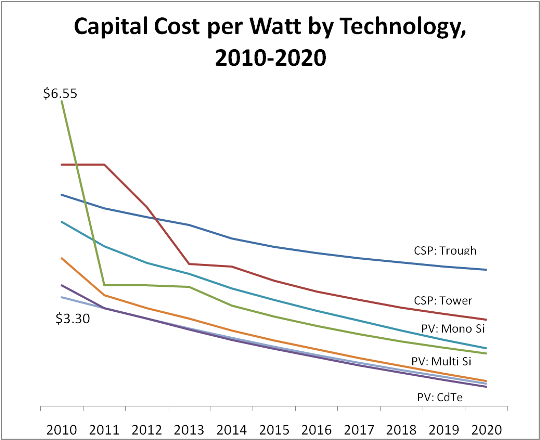
This is a particular problem for clean energy technology, because the capital costs in this area are higher than previous high-tech success stories in the United States such as IT or biotechnology. No investor in today’s marketplace can match these capital requirements by themselves. Our competitors in Asia and Europe have set up institutions to address the problem. They have already successfully lured companies to commercialize and manufacture their U.S.–developed clean energy technologies in those markets. We need to set up similar institutions if we hope to support clean energy jobs here in the United States.
The fourth element I mentioned was support for manufacturing. If we want clean energy jobs, we need to have policies to encourage manufacturing to occur here. In addition to providing a predictable market for clean energy and a robust financing capability for first-of-a-kind projects, we need to have incentives for manufacturing the critical components for clean energy technologies. Other countries, most notably China, have complemented their clean energy market standards with robust tax incentives and other fiscal subsidies specifically targeted at manufacturing clean energy components. And as a result, the U.S. has gone from being a world leader in producing clean energy technologies and enjoying a “green trade” surplus of more than $14 billion in 1997, to a “green trade” deficit of nearly $9 billion in 2008. We cannot afford to sit idly by as our economic competitors move clean energy manufacturing steadily overseas, and deprive Americans of solid job opportunities.
So these are four key strategic elements that need to be included in any energy legislation in this Congress, if an energy bill is to help us compete in global energy markets in the future. None of these individual ideas are new, but their interconnection is now more apparent. A few years ago, we thought that we could do just one or a few of these things and be successful. It is now clear that you must do all four of them and do so on a level that is competitive with what other countries are doing.
Let me now describe some of the specific policy initiatives that I think will be very timely for us to pursue in the Senate this year. Most of these initiatives will be items I hope to champion in the Committee on Energy and Natural Resources. This is not intended to be an all-inclusive list. The committee has 22 Members, many of whom have just been appointed. I anticipate a lot of meetings and bipartisan dialogue over the next few weeks as we work out our legislative roadmap for this Congress. But the following topics are issues that I think are particularly crucial for us to address. They are also issues where we did have strong bipartisan consensus in the 111th Congress. This gives us a good place to start our deliberations this year.
The cheapest energy is the energy we do not have to use by operating more efficiently. So, clearly where I’d start with is energy efficiency. In the last Congress, we had a very productive dialogue in the Energy Committee and among businesses, manufacturers, and efficiency advocates interested in appliance and equipment energy efficiency. The result was a package of legislative provisions that codified consensus agreements to update certain existing appliance standards, to adopt new appliance standards, and to improve the overall functioning of the Department of Energy’s efficiency standards program. Many of these efficiency provisions were part of the comprehensive energy bill we reported out of Committee in 2009. Others were subsequently approved by the Committee or part of bipartisan bills.
These sorts of standards are essential if U.S. appliance manufacturers are to remain competitive in world markets, which will increasingly demand highly efficient appliances and equipment. By ensuring a strong domestic market for energy efficient products, we keep innovation and jobs here in America, while realizing significant energy and water savings, and major cost-savings to the American consumer.
Obviously we had great difficulty in getting any sort of legislation though in the lame duck session of the last Congress; we were not able to enact these consensus provisions. We had overwhelming, broad bipartisan support, but not unanimous support in the Senate. This is an important piece of our early agenda in this Congress, and I hope we can introduce it soon. My staff has been working with the consensus group of stakeholders on some further technical changes to last year’s package. I plan to introduce a revised package within the next week or two.
There is also much that can and should be done to promote efficient use of energy in other parts of the economy.
In residential and commercial buildings a broad coalition supported Home Star, a program for residential building efficiency. I hope we can move forward on this. Similar interest was apparent with commercial buildings in a program called Building Star. I hope to move one or both forward. In transportation, two proposals from last Congress deserve a closer look.
First, we should provide a greater point-of-sale incentive to vehicle purchasers, with dealership rebates that would be larger for the more fuel-efficient cars. Senators Lugar, Snowe and others cosponsored this legislation with me in the last Congress. A second set of proposals dealt with diversifying the sources of energy that we use in transportation. This bill was Senators Dorgan and Alexander’s proposal and passed out of the Energy Committee on a very large 19-4 vote.
Energy efficiency in manufacturing and industrial operations is also important. The legislation reported by the committee last year contained a comprehensive program on manufacturing energy efficiency that had good bipartisan support. Again, I hope we can move forward with this legislation, too.
Another priority is the one highlighted by the President in his state of the Union speech – moving to a cleaner energy mix in the way we generate electricity.
For a number of years I have advanced a proposal for a Renewable Electricity Standard, to ensure a long-term and predictable demand for renewable clean energy resources. The President proposed to expand upon that concept by including a broader suite of technologies such as nuclear energy, coal with carbon capture and storage, and natural gas generation. The President’s stated goal, as he described it, is to achieve 80 percent of our electricity from such clean energy sources by 2035. The White House has asked us to work with them to see how the provisions for this Clean Energy Standard would be developed. Obviously, there are a lot details to work out. I am pleased that the Administration has reached out to the Committee to consult on this subject.
Perhaps no topic garnered more scrutiny during last Congress’s markup that the Renewable Electricity Standard. I plan to work with colleagues on both sides of the aisle in the Committee to determine how we can craft a workable legislative proposal to achieve what the President has set out as his goal. As we do so, a number of key design questions will need to be answered, such as, what counts as a clean energy technology? How does the proposal account for existing clean energy sources? Does the credit trading system that we have developed for renewables in our proposal for renewable resources fit with these other resources?
With respect to financing assistance for energy projects, I think there are at least three top priorities for early attention in this Congress: reforming the current loan guarantee program for clean energy projects, providing financing support for advanced energy manufacturing in this country, and providing reasonable stability and predictability in the tax provisions that apply to clean energy projects and technologies.
The first of these is to replace the current loan guarantee program for clean energy technologies with a Clean Energy Deployment Administration, or CEDA. CEDA would be a new independent entity within DOE, with autonomy like the Federal Energy Regulatory Commission has. It would provide various types of credit to support deployment of clean energy technologies including loans, loan guarantees, and other credit enhancements.
This proposal was strongly supported on a bipartisan basis in the Committee as part of the larger energy bill we reported. It also had a broad range of external support from clean energy developers, innovators, and venture capital firms. Fixing the problems of the current DOE loan guarantee program, and ensuring that we have an effective financing authority for a broad range of clean energy technologies, including renewables, nuclear, energy efficiency, and carbon capture and storage, needs to be one of our highest priorities. I am committed to moving ahead with that legislation in this Congress.
The second priority in the area of financing assistance relates to encouraging the location of manufacturing facilities here and replenishing the fund to award tax credits under section 48C. This section provides up to a 30 percent tax credit for the costs of creating, expanding or reequipping facilities to manufacture clean energy technologies.
The initial funding was vastly oversubscribed – the government received $10 billion in applications for $2.3 billion in tax credits. This is a powerful demonstration of the potential for clean energy manufacturing that exists in this country. In the last Congress, Senators Hatch, Stabenow, and Lugar joined me in filing the American Clean Technology Manufacturing Leadership Act. This bill would have added another $2.5 billion in tax credit allocation authority. President Obama has since called for an additional $5 billion. I hope we can help reintroduce bipartisan legislation to ensure this credit’s continuation at the President’s proposed level. While this is a matter that will be handled in the Finance Committee, it is an important near-term bipartisan opportunity in this Congress.
The third essential element is to bring stability and predictability to this part of the tax code in order to attract private capital to clean energy projects. If you look at this part of the tax code, many of the energy-related tax incentives will expire at the end of 2011, including the section 1603 program, the credit for energy-efficient residential retrofits, the credit for construction of new energy efficient homes, the credit for energy efficient appliances, the incentives for alcohol fuels (mostly ethanol), biodiesel and renewable diesel. Other energy-related tax incentives are set to expire at the end of 2012, 2013, and 2016.
One other major challenge and priority for the Committee in this Congress will be to address the proper and effective regulation of energy development to order to protect the public health and safety and the environment. I met this morning with Michael Bromwich, the Director of the Bureau of Ocean Energy Management, Regulation and Enforcement (BOEMRE). Clearly he is working very hard to get his arms around this critically important issue.
One of the important lessons learned from the National Commission on the Deepwater Horizon Oil Spill is that, in the long run, no one –least of all the regulated industry – benefits from inadequate regulation and underfunded regulators. In the aftermath of the Deepwater Horizon disaster, the Committee on Energy and Natural Resources last June came together and unanimously voted out a bipartisan bill to address the key problems uncovered by our hearings on the disaster. Unfortunately, Congress did not enact our bipartisan bill.
Our first hearing of this Congress, last week, heard from the co-chairmen of the President’s Commission on their recommendations. I hope to introduce on a bipartisan basis a follow-on bill to last year’s legislation in the near future. I hope that we can repeat our bipartisan success of the last Congress in developing a bill that recognizes our need to develop the rich resources of the Outer Continental Shelf, but also minimize the potential impacts of developing those resources on the marine and coastal environment and on human health and safety. This is important work that needs to be completed.
Finally, an item that I hope we can address early in this Congress in the Energy Committee deals with perhaps the most pressing energy security problem we have. That is the vulnerability of our electrical grid to cyber attack. A major disruption of the electric transmission grid, or the equipment it contains, as part of a cyber attack could have disastrous consequences. We need to ensure that adequate preventative measures are in place across the grid. The problem is that we don’t currently have mechanisms to ensure that these needed steps are being taken. The whole grid is as vulnerable as its weakest link. In the last Congress, our Committee twice passed legislation to address this need. The House of Representatives also sent a bill to the Senate on this subject, but again, due to the inability to process legislation in any mode other than unanimous consent in the Senate, we were not able to pass the legislation into law, nor take the needed steps to ensure the security of our grid. I hope to work with the Members of the Committee on both sides to deal with this issue early in this Congress.
So in conclusion, I have laid out a pretty aggressive opening agenda for the Committee. This week, we have two hearings – one to advance a bipartisan bill to ensure our nation’s future supply of medical isotopes and the other to raise the curtain on energy activities and issues generally in this Congress.
Next week, Senate Democrats are away from Washington for several days for an issues conference, so our Committee will not have formal meetings.
Following the release of the President’s budget on Feb. 14, we will hear from Secretary Chu on Feb. 16 and then from Secretary Salazar and the Chief of the Forest Service on their budget requests in the first week after the President’s Day recess. When we finish with our duties to scrutinize the Budget request, we will return to legislative hearings on energy. By that time, I hope that we have sufficient bipartisan engagement with both the returning and the new Members of the Committee that we can start making good progress on developing one or more energy bills for the full Senate to consider in the first several months of this year.
Thanks again to Simon Rosenberg and the NDN for giving me this opportunity to talk about our agenda for the early part of this Congress.
Sen. Jeff Bingaman (D-N.M.) is the chairman of the Senate Energy and Natural Resources Committee.




 Posts
Posts


